Posts

The "Real" World

Yoder has a helpful gospel-correction for appeals to the "real" world: "Which is the 'real world'? Whereas contemporary dominant mental habits assume that there is 'out there' an objective or agreed accounts of reality and that faith perspectives must come to terms with that wider picture by fitting into it, as a subset of the generally unbelieving worldview. I propose rather that we recognize that we are called to a believing vision of global history, suspicious of any scheme of analysis or management that would claim by itself to see the world whole apart from faith or apart from avowing its own bias. The modern world is a subset of the world vision of the gospel, not the other way around. That means we can afford to begin with the gospel notions themselves and then work out from there, as our study has done, rather than beginning with the 'real world' out there (someone else's definition of 'the nature of things') and then trying...

Sacramental language in the Immanent Frame

At the end of my last post,  I raised some concerns with the possibility of the kind of  resourcement advocated by Boersma in his very interesting book, Scripture as Real Presence.   It wasn't until, today, while having coffee with one of Boersma's former students that I was able to grasp the problem more clearly. In my last post I wrote: Is the recovery of the sort of sacramental, pre-modern exegesis possible today? If so, what would it look like? As a theologian, I appreciate the coup that this would be for a dogmatic account of Scripture, but can we actually reclaim the neo-platonic infrastructure necessary to support such an account? The genius of the Fathers was their ability to use the best philosophical tools at their disposal to fill out their theological claims about Scripture. In our post-modern context where we have witnessed the death of metaphysics proclaimed by Nietzsche  et al,   how do we go forward? Charles Taylor has expressed the ...

Scripture as Real Presence: A Review

Image
Boersma, Hans. Scripture as Real Presence: Sacramental Exegesis in the Early Church .  Grand                Rapids, MI:Baker Academic, 2017. Hans Boersma's recent book, Scripture as Real Presence  is a valuable work of resourcement (273) for the contemporary upsurge in the Protestant interest in the theological interpretation of Scripture. Boersma's thesis is two-fold: Modern biblical scholarship has bracketed out questions of metaphysics, creating a crisis for dogmatic descriptions of Scripture , AND,  the church should recover the sacramental understanding of the Bible that rests on the Christian Platonism of the Fathers. In my Old Testament Theology course in seminary, one of the assignments we had was for each student to present a snapshot of a different scholar's OT theology. It was a large class (for that school), so we ended up covering around 20 different OT theologies that ranged from the late 19th century to toda...

The Joy of Academic Reading: Why Wittgenstein and Derrida are not the same

Academic reading can be a chore. For some reason, experts often engage in a sort of linguistic torture that leaves readers bored, confused, and emotionally drained. But every so often, one encounters a piece of academic writing that makes the soul sing. This was the treat that awaited me today as I read Toril Moi's 2009 essay, " They practice their trades in different worlds": Concepts in Poststructuralism and Ordinary Language Philosophy ." Over the past year I wrote a thesis on Stanley Hauerwas that featured a chapter on his indebtedness to Ordinary Language Philosophy. I was frustrated by the constant criticisms of the "linguistic turn" in Hauerwas' work that often came from a group known as the "Biola School." Their criticisms seemed to me to be off-base somehow, but I could never quite articulate a satisfactory account of what these folks got wrong. I supposed that they simply had not undergone the Wittgensteinian therapy necessary to r...

Six Books that Changed the Way I Think (And the People who made me read them)

Mircea Eliade, The Sacred and the Profane. In my third year in college, I took a class from Prof. Cameron McKenzie on the Latter Prophets. It was a seminar style class that involved a crash course in Old Testament and Ancient Near Eastern prophecy as well as a series of student paper-presentations on the book of Ezekiel. As this paper was worth the majority of our grade, we were all required to consult with Cameron on what we would be writing. It was in one of these meetings that Cameron introduced me to this philosopher who would go on to radically change how I read the whole bible. Eliade, a philosopher of religion, argues that across the ancient world there was generally a much more robust participatory ontology operating in the social imaginary than there is today. His discussion of types and archetypes was essential reading for me as preparation to engage the neo-platonism that underwrites Christian sacramentalism and Patristic exegesis. For anyone struggling to enter into the...

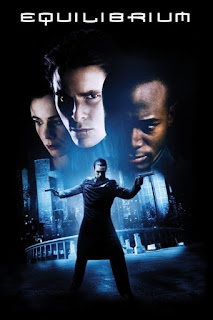
Equilibrium and Revolution

Image
Kurt Wimmer's 2002 film, Equilibrium  gives us an interesting lens through which to view the Russian revolution of 1917 on this, its centennial. Set in the latter half of the 21st century, the world has passed through World War III and has attempted to construct a society in which war is no more (Woodrow Wilson is surely smiling up from the grave). To do so, the political elites have located the problem of war in the facts of human nature, specifically in our capacity to feel. It is our passions, in a passing homage to Girard, that are the root of the violence that manifests itself so devastatingly in war. The decision is made that to suppress our more base desires and passions, we must also sacrifice the heights of human emotion; joy, love, etc. Thus, a drug is created to produce an emotional equilibrium in the populace. Under the effects of this new opiate, peace is declared; a peace that is maintained by a para-military order of pistol wielding monks. On the surface, the movie...

Reformation 500: Triumph and Tragedy

As we commemorate the 500th anniversary of the beginnings of the Protestant Reformation, I must admit, I am deeply grieved. I resonate with the story Archbishop Justin Welby shared in the Evening Standard  as he recounted the tears that streamed from both his and his Catholic counterpart's faces at a recent celebration of the Eucharist wherein they could not share table fellowship. The disunity and shattered state of modern Protestantism is a grave sin, and one that should not be lightly overlooked. Appeals to the original intent or goals of the Reformers do little to mitigate the disaster which is the fractured and broken church today. Yet it is not all bad news. The spirit of the Reformation has positively affected the world in many ways, through music, art, literature, science, good government, ecological protections, etc. Most significantly, the Reformation spirit even managed to bring about many of the reforms within the Roman Catholic Church that were called for in the 16...